R$10 — Ten Reais

The artwork
Front: Pedro Álvares Cabral in blue line engraving, bearded and looking straight out, above his name in small capitals. Behind him, in brown, a landscape of the new-found coast: forest, birds and animals, men felling trees and raising a cross. Portuguese caravels sail through the orange 10 at right; at left, a portolan compass rose and lines of old chancery script over a clear window carrying a printed rosette.
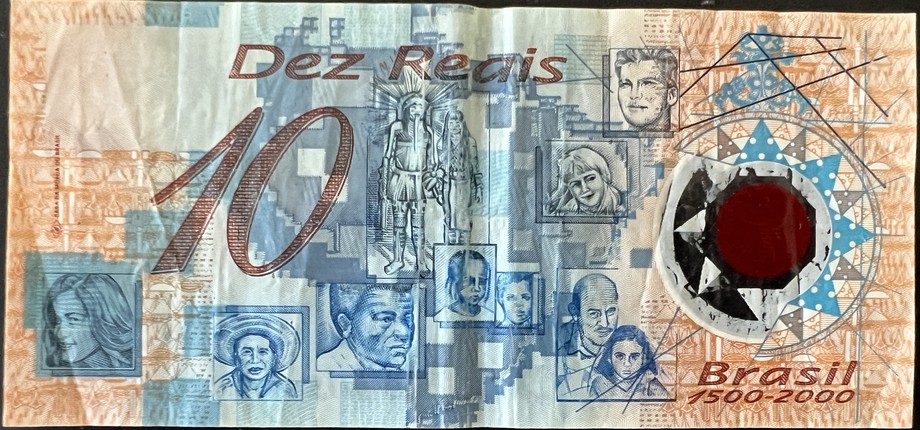
Back: A montage of Brazilian faces, engraved in blue as if pinned in frames across the note — a young woman, a man in a straw hat, an older man with a child, an indigenous girl — with two figures in feather dress standing at the centre in a burst of rays. A large red-brown 10 fills the left, and "Brasil 1500-2000" sits under the second clear window at right.
In circulation
Issued in 2000 for the quincentenary of the Portuguese landfall, alongside the ordinary paper 10 reais rather than in place of it. Brazil's first polymer note, and its only one; the experiment was not repeated. Still legal tender, but long since gone from tills, and superseded by the second-family 10 reais from 2010.
Details
- IssuerBanco Central do Brasil — "Dez Reais"
- CurrencyReal (R$)
- DenominationTen Reais
- Collectedon the Brazil journeys, 2004–2005
- SeriesCommemorative issue, Brasil 1500-2000; serial A 0573015728 D
- PrinterCasa da Moeda do Brasil
- SecurityPolymer substrate with two clear windows, the larger printed with a rosette device
- SignatureMinistro da Fazenda and Presidente do Banco Central do Brasil