K100 — One Hundred Kyat
The artwork
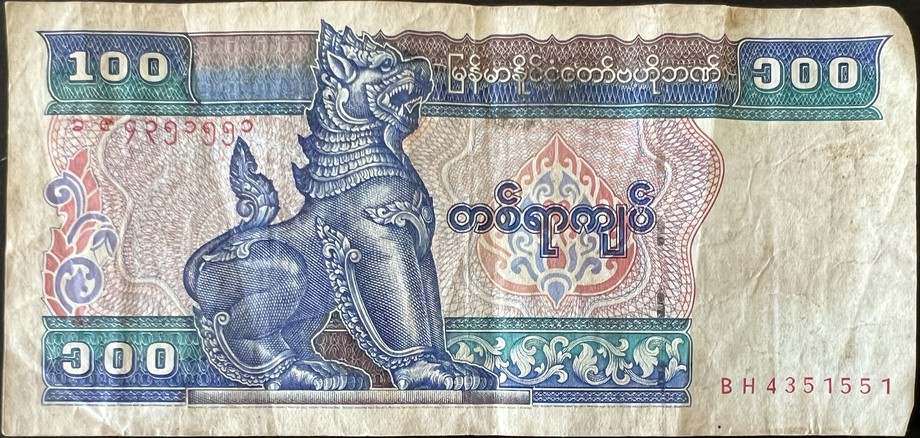
Front: A chinthe, the mythical leonine guardian that sits in pairs at the foot of Burmese pagoda stairways, rendered in deep blue and shown seated in three-quarter profile with flame-like mane and scaled haunches. The top panel carries the bank's name in Burmese script; the value appears as 100 in Western figures and ၁၀၀ in Burmese numerals, with "one hundred kyats" spelled out in Burmese over a red lotus-leaf cartouche. Red serial, Latin prefix.
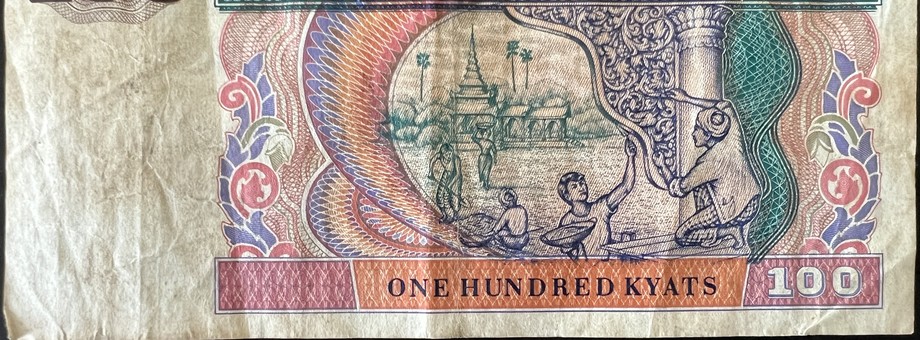
Back: A working scene: craftsmen seated on the ground with round trays and tools, one reaching up to a richly carved column, another kneeling at a plank. Behind them, a tiered pagoda spire and pavilion roofs among palms, drawn faintly in green. The whole is framed by orange and violet peacock-feather guilloche and floral corner medallions, with ONE HUNDRED KYATS in an orange band across the foot.
In circulation
Part of the Central Bank of Myanmar's 1994 issue and still legal tender, though inflation has long since pushed daily trade onto the 1,000, 5,000 and 10,000 kyat notes introduced from 1998 onwards. The design has not been replaced; hundreds simply turn up worn and soft, as this one is.
Details
- IssuerCentral Bank of Myanmar, named in Burmese across the top panel
- CurrencyKyat (K)
- DenominationOne Hundred Kyat
- Collectedon the Burma journey, 2001
- Series1994 issue; undated, as all Burmese notes of the period
- WatermarkChinthe head
- SignatureNone — the note carries no signatures or titles