₹10 — Ten Rupees
The artwork
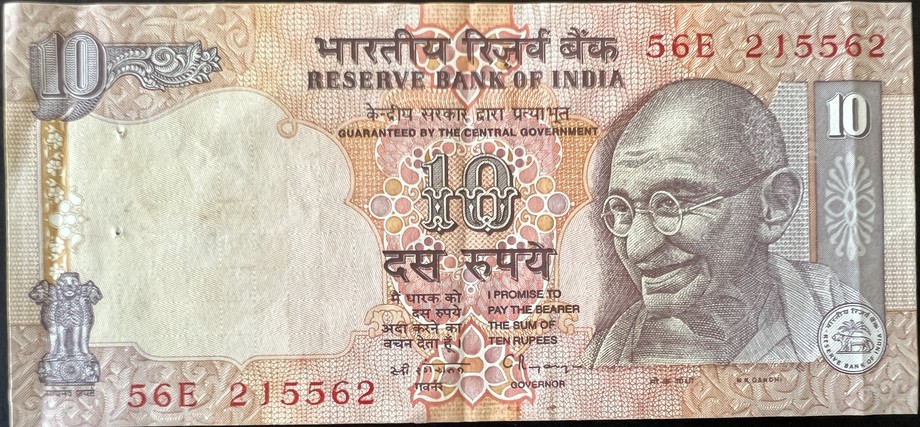
Front: Mahatma Gandhi at the right, smiling, in the familiar 1946 portrait that took over the face of Indian currency from 1996. Centre, the value in Hindi and English — दस रुपये, TEN RUPEES — set in a rosette of small floral discs, above the Reserve Bank's promise to pay and the Governor's signature. Lower left, the Lion Capital of Ashoka; right, a silver band carrying the numeral 10.
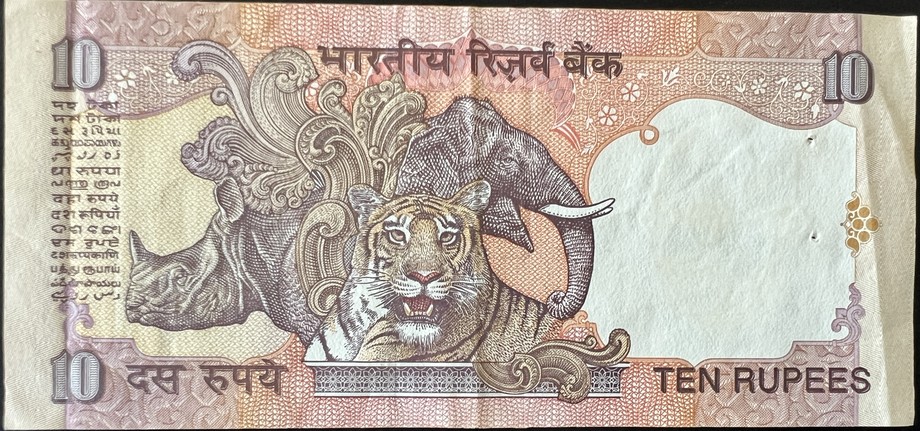
Back: A crowded wildlife group in ornate scrollwork: an Indian rhinoceros in profile at the left, a tiger's head snarling at the front, and behind them an elephant with one tusk raised. It is the reverse that gives the series its collectors' nickname. Down the left edge, the denomination in the fifteen other official languages; TEN RUPEES and दस रुपये along the foot, 10 in each upper corner.
In circulation
Introduced in 1996 as part of the Mahatma Gandhi series and printed in very large numbers for two decades, with security features tightened along the way. Superseded in January 2018 by the chocolate-brown ₹10 of the Mahatma Gandhi New Series, which carries the Konark Sun Temple chariot wheel on the back.
Details
- IssuerReserve Bank of India — "Guaranteed by the Central Government"
- CurrencyRupee (₹)
- DenominationTen Rupees
- Collectedon the India journeys, 1992–2018
- SeriesMahatma Gandhi series, from 1996 — the "Gandhi–wildlife" ₹10
- SignatureGovernor, Reserve Bank of India
- WatermarkMahatma Gandhi portrait with electrotype 10 in the blank panel
- SecurityWindowed security thread and latent-image band at the right