Bs100000 — One Hundred Thousand Bolívars
The artwork
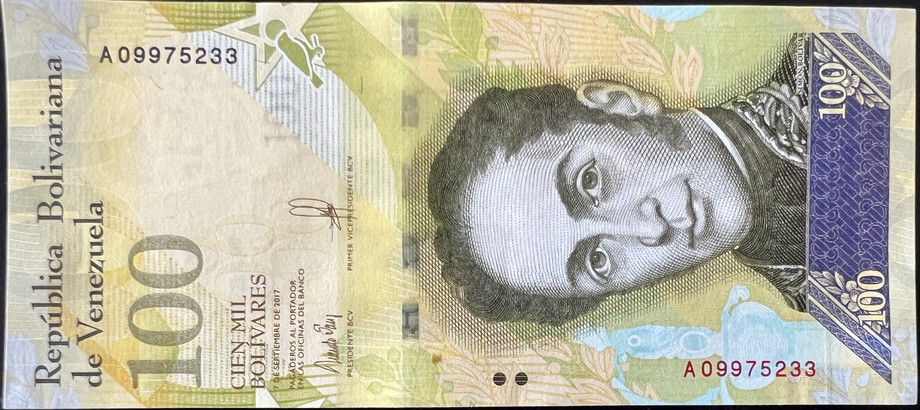
Front: Simón Bolívar in the familiar three-quarter profile, in high uniform collar, engraved in grey against yellow-green and pale peach guilloches of stylised leaves and flowers. The denomination reads vertically at left — a large 100 over CIEN MIL BOLÍVARES — beneath the country name, República Bolivariana de Venezuela. A blue-violet panel at right carries 100 twice and Bolívar's name in microtype; serial numbers appear in black above and red below.
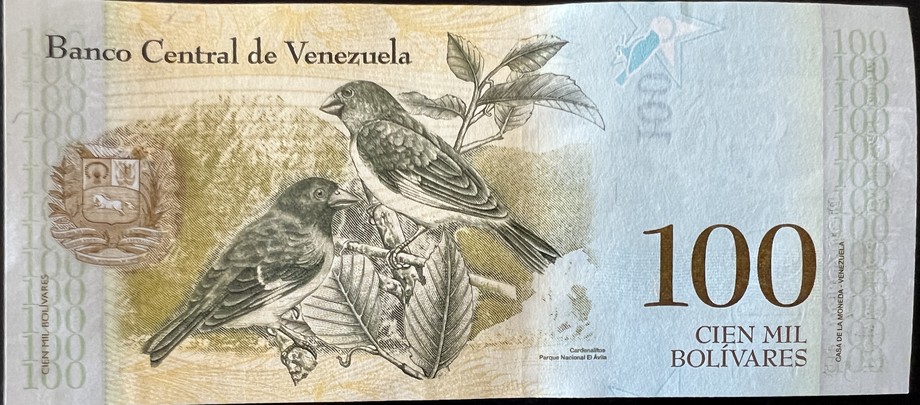
Back: Two cardenalitos — red siskins — perched on a leafy branch above scrubby hillside, captioned Cardenalitos, Parque Nacional El Ávila. The little finch is Venezuela's own, trapped almost to extinction for the cage-bird trade. The national arms sit at left in warm brown, Banco Central de Venezuela across the top, and the value in brown at right against pale blue: 100, CIEN MIL BOLÍVARES.
In circulation
Dated 7 September 2017 and issued that November as the top note of the bolívar fuerte, a denomination born of runaway inflation. It lasted barely a year: the redenomination of August 2018 cut five zeroes, and this 100,000 became one bolívar soberano before being demonetised outright.
Details
- CurrencyBolívar (Bs)
- DenominationOne Hundred Thousand Bolívars
- IssuerBanco Central de Venezuela
- SeriesBolívar Fuerte, dated 7 September 2017
- PrinterCasa de la Moneda de Venezuela
- SignaturePresidente and Primer Vicepresidente del BCV
- Dimensions156 × 69 mm