Mercator's World Article: A Travelers' Tale of Bombay
This was an article Mercator's World asked us to write for their first volume of magazine publication. I found printed copies of the magazine in London, England and purchased the stack.
A Travelers’ Tale of Bombay
Clinging
to maps when the going gets tough
By Bradley P. Robinson and
Richard Morris
Third-world political mayhem was not exactly what Rich and I had been seeking when we departed London in September for a year of circumnavigating the globe. But when we arrived in Nairobi on December 29, after being in Africa for three months, political mayhem was what we found.
Two days earlier, Kenya’s first free, multi-party elections in 26 years had sparked an uprising that forced the current president to seal the country’s borders and close Kenya’s radio and television stations, and hoards of people representing the various political parties were protesting in the streets.
After already having had machine guns pointed in our faces near the border of Zaire and Uganda just a few months earlier, we didn’t need to think long before catching a taxi to the airport to hop a flight to Bombay; I wasn’t about to wait around to see who won the election.
Charting a CourseCruising at 30,000 feet in the elitist sanctuary of the Air India airplane for six hours left us ample time to peruse our India guidebook. Our minds were spinning from the anticipation of exploring a new country — must see the Taj Mahal, the backwaters of Kerala, this palace, that monument. Our only guides were our adventurous spirits and the maps of many beckoning destinations.
We spent a lot
of time studying the maps, not only of our imminent destination, Bombay, but
Aurangabad, Goa, Cochin, and other exotic locales. We pored over the railroads
maps and the color photos, the provincial maps and the highlights section, the
city maps and the things-to-buy section. We managed to plan each and every day
of the next few weeks.
The plane was due to arrive at 11 PM. Though the Bombay riots over the Hindu demolition of a Muslim mosque had ceased a few days earlier, we were still somewhat uncomfortable about arriving in the city at so late an hour. We’d heard there were still curfews in certain areas of the country. Would the city be closed for the night? Would we be able to find our hotel? What unknowns might be lurking in the shadows of this strange, foreign city?
The View from HereThe plane began to ease downward, and little by little the lights of India invaded the cabin. Soon the land became discernible, and Rich anxiously scanned the guidebook’s passport-photo-sized map of greater Bombay. Though once situated on many islands, today Bombay lies connected as a narrow peninsula surrounded by sea. Outside, thousands of street lights of the city accentuated the peninsula’s shape, almost mirroring the map in our guidebook.
As the plane meandered above the city, Rich ingested the city’s layout, comparing the map to the view as he forged mental notes of the general direction to Colaba, the section of town where we would be staying.
The Bombay airport was calm and empty: no lines at immigration or customs and no hassles at the currency exchange counter. It was almost too easy. Because of the late hour, we decided to splurge for a taxi, leaving the public transportation adventures that we usually enjoy for the rest of our trip. Airport taxis are pre-paid in Bombay; there are no meters. So we promptly paid our 115 rupees to the driver assigned to us and gave our destination as the Taj Mahal hotel, the ritziest, most famous hotel in town. We picked the Taj Mahal not because we were staying there, but because we thought it would be an easy landmark for the taxi driver to find — our final destination being in the budget hotel district behind the Taj.
The airport taxi agent relayed our desires to the driver. Some talk was exchanged in Hindi, accompanied by affirmative nods and smiles, from which I erroneously gathered that the driver knew where we were headed. We put our backpacks in the trunk, piled into the circa 1933 auto left over from the British Empire and sped off into the Indian night. Rick kept the book with our Bombay map sitting safely in his lap.
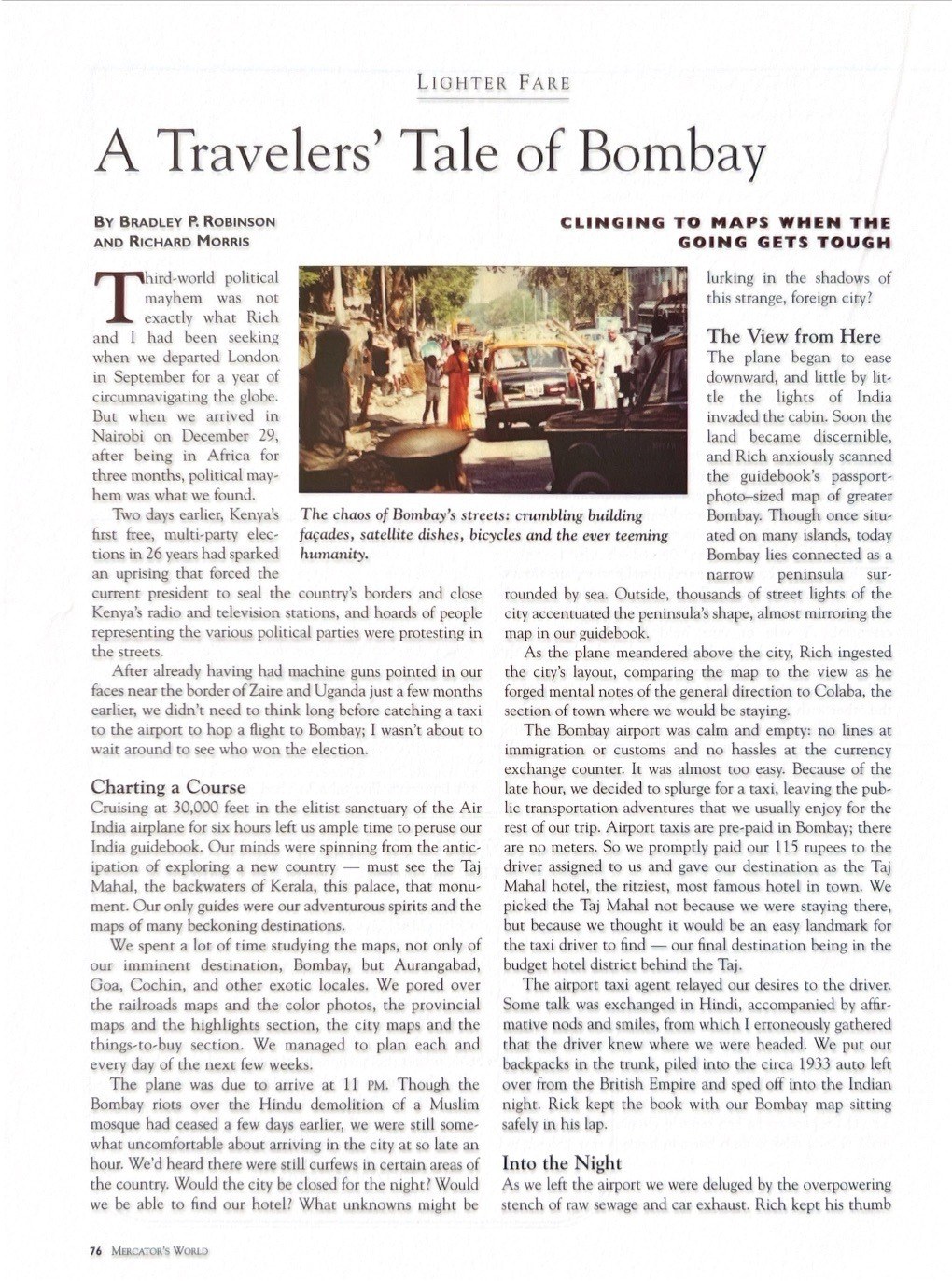
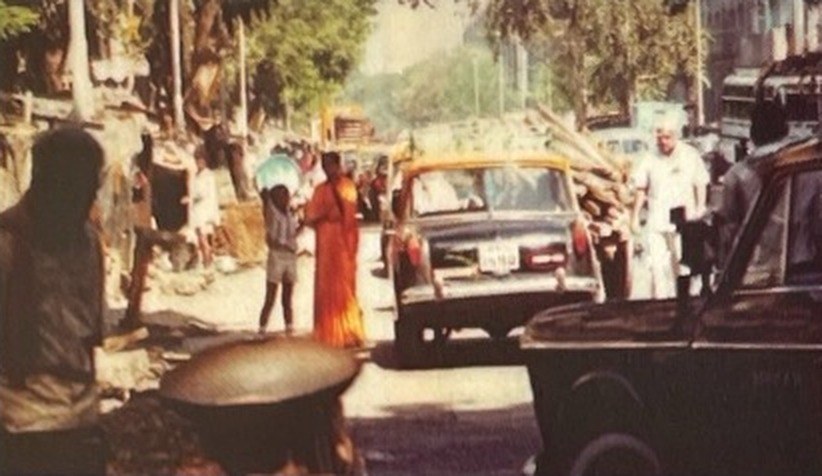
Into the NightAs we left the airport we were deluged by the overpowering stench of raw sewage and car exhaust. Rich kept his thumb on the map, glancing down periodically to guess our position. But the world outside the cab begged for our constant glances. The streets were overflowing with people, and street scenes ranged from dirty building façades with chipped paint to cardboard row houses adorned with satellite dishes.
Each time Rick rechecked our position, those downward glances to the map appeared to be a welcomed return to the familiar — a chance for him to catch his mental breath.
Driving down a six-lane road divided by a raised cement island and closely walled by five-story decrepit façades, we noticed that the other side of the street was littered with street repair and maintenance equipment. Interesting, we thought, and continued with the usual round of glances — straight, left, up, down. From Rich’s thumb we gauged we were about halfway to Colaba.
Suddenly, peripheral movements from the right swung our eyes back toward the street repair. Amidst the usual traffic cruising at reckless speeds, we saw various vehicles avoiding the construction obstacles by driving over the center concrete island and sidewalks. Shocked as I was at this driving spectacle, it wasn’t until the opposite side of the street closed down completely and the oncoming traffic conveniently began to share our side of the street that my opinion of Indian driving habits solidified.
It was here that Rich chose to let go of the guidebook so he could use both hands to hold onto the door handles. One sharp swerve around a bicycle sent our only grasp on reality in this chaos — our Bombay map — tumbling onto the floor of the cab.
Losing Our WayWith the ever-present confusion and excitement outside, and the map lying disheveled on the floor of the cab, we had to content ourselves with guesswork on our approximate location. Our worries were squelched, however, when the cab made its way into Colaba and the view of the water was easily matched to our memory of the map that we had studied so vigorously on the plane.
As the cab turned away from the Back Bay we knew we were within two kilometers of the Taj. As we sat back, confident that we would, indeed, make it to our destination, the taxi suddenly stopped outside a strange hotel whose name was nothing close to the Taj Mahal. The driver proudly proclaimed this as our destination, and hurriedly attempted to shoo us from his cab.
When we retrieved our map from the floor of the cab, we were sure we hadn’t yet arrived. The Taj was located on the eastern harbor; we were parked near the western bay. Failing to get us into the mysterious hotel, the driver tried next to get us into another taxi, which would require another fare. It was then that we realized the driver was lost. But since we had already paid for the trip, we declared that we weren’t budging from our seats until we reached the Taj Mahal. Reluctantly, the driver acquiesced.
From a glance at the map Rich knew the general direction in which we needed to go, but was unable to explain this to a driver who spoke very little English. It seems he did not share our appreciation for the small illustration of lines and names — the map we clung to for security and comfort — and we had no other way to communicate. We drove in circles for 30 minutes, stopping every few blocks to ask directions from the many pedestrians that flooded the streets.
It was past the point of pathetic when we stopped our fourth man for help. This time, however, rather than provide directions to the driver, the bypasser excitedly joined us in the cab and declared himself our guide. Within two minutes we were in the Taj neighborhood.
Though our self-appointed guide first took us to several of his friends’ hotels in hopes of drumming up a bit of income for them, we remained strong. At 11:50, we arrived at the hotel we wanted, the hotel we’d so carefully chosen from the guidebook during our six-hour plane trip, when it had all seemed so simple and straightforward.
A New ChallengeWe’d been traveling through the African bush for months before this trip, navigating our way with the help of our maps. But now we were mentally drained from just one hectic hour of trying to navigate through Bombay.
As we again peered through the guidebook to review the next day’s agenda, we realized that, though we had all the tools needed for our journey, communication would be the true challenge as we explored this strange and alluring new culture. We could only hope that our future contacts would prove more willing to share the universal language of maps.
Mercator’s World, Volume 1, Number 2 (1996), pp. 76–77