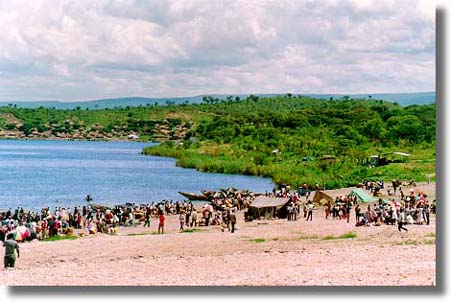
We got up, took down camp and started driving. We had to be in Goma today, no matter what, and the roads were flatter than usual so it was pretty smooth riding. We were told we were going to drive until we got to Goma – we needed to book the gorillas – be it midnight if that’s what it took. We drove all day around Lake Kivu, stopping for an hour for lunch, then continuing to drive forever. It got dark and we kept driving. I sat next to Tom and amused myself simply by having a conversation with him – he’s a bit dim as you know. Finally got to Goma at 9:30 p.m. and everyone was starving. Dinner began, but I started immediately into the rum and cokes. Jenni joined me after my first drink, so the two of us proceeded to finish off the bottle of rum then move into another half bottle of vodka. We were both stumbling drunk by 3:30 a.m. so we staggered to bed.
|
||||
|
We went to Kahuzi-Buega National Park before leaving for Goma, and that was so we could pay five dollars to go see what our courier thought was a pygmy village. Since we had an incompetent courier who couldn’t lead a group of people out of a paper bag this pygmy village turned out to be a bunch of tea plantation workers who happened to grow dope as well. Dope trees abound, more than I’ve ever seen in my life, but not worth any money to see, let alone five dollars. It sucked and was a total rip off – all thanks to an incompetent courier. Speaking of thing we used to do on the truck – there’s Raewyn, one of the Kiwi girls. Raewyn would always sit on one of the outside seats and would proceed to wave like crazy at any and all locals within her range of peripheral vision. I sat there and watched her for a while and figured out that she thought she was the Queen of England spreading goodwill and homeliness and that every local she waved at should wave back. If the locals didn’t wave back she’d lean out of the truck wildly waving her hands harder while screaming “Jambo” – welcome in Swahili in an attempt to get a response. Amusing to watch her, but even more amusing to see the expressions on the locals’ faces. The way the locals looked at Raewyn made me think that they were thinking, “Who’s the silly bitch hanging out of a blue mzungu truck screamin ‘Welcome’?” Remember I mentioned the Zairian boys throwing rocks? If I were a native and I saw Raewyn acting the way she was I’d throw rocks too – I don’t blame them. We drove all day, finally reaching the shores of Lake Kivu where we camped in a school yard for the night. That evening Brenda, Rich Tom (the plumber) and I were standing around the fire talking to one of the teachers when tom made a major faux pas. Tom wasn’t that clued in as to the ramifications which can occur if you bag on the ruling dictator while talking to the locals (who could always be the police). He and the school teacher were talking away when the teacher asked Tom if he knew about Zaire’s president. Tom’s response was, “What, that he sucks?” Rich, Brenda and I all heard that and immediately all of us started screaming NO! NO! NO! NO! The school teacher saw our reaction and said he didn’t like the president either. It was only after Tom saw our reaction to his comment that he watched what he said to the locals. Tom is a dim bulb, but he is amusing to be around – just to hear what the next outrageous statement to come out of his mouth is going to be. We headed out early and hit the Zairian border in the mid-morning. Zaire is a total dictatorship – as bad as one can get – so the bureaucracy is massive. We’d read a few weeks earlier that the Prime Minister wanted to have some governmental body directly elected, but the ruling dictator – Mbutu – didn’t like that idea so he told the Prime Minister to dismiss his cabinet and reappoint the dictator’s men to those posts. The Prime Minister refused so Mbutu moved in the military and basically ousted most of the cabinet members. It was a very low-key coup d’etat, and here we were at Zaire’s border waiting to get in. We cleared immigration without any problems, but the customs guy was just being a dick and told everyone to get off the truck so he could inspect it. He opened our food stores and after discussing the merits of which country the milk powder was manufactured in with our driver he let us through. Had the milk powder been made in Kenya he would have kept it, as Zairians have great respect for Kenyan-made products. We stopped for lunch near Uvira where a little old Zairian woman with a cane wandered right into the middle of our group. I climbed into the front with Stefanie and Boz (who was driving) for this next leg of the journey. We drove a few hours but then we came upon a customs and immigration post. We sat there for a second thinking, “Why would Zaire have two customs posts?” The reason was that it wasn’t Zaire at all – it was the border post with Rwanda! Rwanda’s currently in the throes of their own civil was, so no tour companies are transiting through there any longer. One of the Rwandan police told us we didn’t want to go into Rwanda because the bandits have been robbing safari trucks as they transit through. Evidentially we’d taken a wrong turn somewhere. We thanked the police officer (who then asked us for five dollars and got nothing), did a U-turn and headed up the muddy roads higher and higher into the Zairian mountains. It rained a bit making the road muddier and the truck harder to control, plus the temperature was dropping. We persevered by drinking Primus and eating the pineapple which had been soaking in the rum from our punch the night before. We finally hit the summit and descended (more slid) through the mud to this quarry at the base of the mountains. It was dark by this time so setting up camp was on our agenda. As usual a few locals came and watched us, so I approached them to practice my French some more. I found out from them that there was a natural hot spring not twenty meters from our campsite – we’d just missed it because it was dark. I thanked them for the information and told them they could show us in the morning.
After breakfast we headed through the mountains down towards the north point of Lake Tanganyika to the city of Bujumbura, Burundi’s capital. Burundi’s rather modern, with the greatest paved roads going up and down their mountains – a nice change form our hell Tanzanian road. We had nothing better to do than drink Primus all day. Since we were still a little concerned about Kenya Rich, Stefanie and I (the three token Americans) headed over to the embassy to find out what our government was saying about the situation there. We met with a consular officer who told us that U.S. officials have been advised not to go to Kenya, but tourists could still go – for now. The Kenya/Uganda border which is technically closed is letting tourists through, but that’s all. When we asked about Nairobi the officer told us our embassy there was replacing about three passports a day – nice crime rate! He also told us that six people were killed in demonstrations in western Kenya, so their political problems were not getting any better in the lead-up to the election. We left and wandered around Bujumbura for the day – we still had to hear the result of a call our courier was placing to Kumuka’s head office in Nairobi to see if we would be entering the country. When we got back to the campsite we were told we were going into Kenya and that we’d be leaving the next morning for Zaire. Not too pleased with that decision Rich and I proceeded to make a spirits punch for everyone to partake of before heading to Zaire where no goods or services are available. Our campsite sat on the northern end of Lake Tanganyika and there are a lot of hippos living in the lake so we were warned to watch out for them coming into the campground at night. After a few glasses of punch Tom, Jim, Stef and I went hippo hunting down near the water. Sure enough, the huge beasts were no farther than one meter from the edge of the campsite climbing out onto the rocks and swimming around just below the barrier. The hippos got bored of us watching them so they slipped into the water and swam off, leaving us to drink more punch and go to bed. We left at noon today headed towards Bujumbura, the capital of Burundi, but not before stopping off at the candy store to spend al our remaining Tanzanian shillings on Cadbury’s chocolate. We headed out of Kigoma on the worst road we’d driven on so are. It can’t even be called a road – it’s more like a large dirt path that people walk on and it was just a coincidence that it was just wide enough for our truck. No road maintenance (pipe dream) so everyone in the back of the truck was forced to take a firm grip onto something stable as not to get thrown out of their seats. It got really deep and muddy at one point and when Mick attacked each mud slide with some accelerator the truck would fishtail and rock and roll more than ever. At times the truck was at a very jaunted angle and we didn’t know if it was going to do an imitation of the inside of a tumble driver or not. It was definitely one of our hell rides on the entire safari When we woke up this morning it was pissing down rain, so we just sat in bed reading until noon when it was time to get food. We went into town for lunch, then since the rain had subsided we sat by the lake drinking beer all afternoon. I ended up going to bed at 4:00 p.m. as I had food poisoning from eating a bad samosa for lunch. Totally ill, but just another one of those trials and tribulations of travelling in a Third World country. I do remember hearing that the truck had finally arrived at about eight o’clock that evening, but I was way too sick to go out and see what was going on. It turned out that the road around the lake was rained out and so muddy that the truck continued to get bogged down in the mud. If Jim, Tom and Mike hadn’t decided to skip the boat the truck would probably still be down there somewhere! They’d been bogged in the deep mud for over seven hours before they could get the truck free. 16th December 1992, Kigoma, Tanzania – With the truck’s arrival our tour began to take shape again. Today was a bit slow as everyone (save the ones who’d arrived the evening before) was sick of Kigoma. We applied for our Burundi visas and ended up just hanging around the hotel bar drinking and killing time. We were supposed to be heading to Burundi the next morning and we were all well more than ready to leave. The truck didn’t arrive last night so today Rich and I are taking everyone to Ujiji, a city near here where Stanley finally found Livingstone and met for the first time. The girls had never been on a packed matatu, so Rich and I showed then the ropes re: riding one. First you must push and shove everyone out of your way to get on, including the little old African ladies, then hold on for dear life because these guys speed and are horrible drivers. We ended up in the middle of Ujiji twenty minutes later when we extracted ourselves from the sardine can which doubles as public transport. We walked around the whole city (concentrating on the market) and after being accosted by the town loon (crazy man) one of the locals befriended us and said he’s take us to the Livingstone memorial. We walked through all the back alleys of the village until we came upon this little museum hidden way in the back of the village. Needless to say we would never have found it had we not met the dude. At the monument there were actual museum employees, and our man gave us the perfect textbook rendition of the historic meeting (in very broken English). David Livingstone was a Scottish missionary who had come down to Africa, and no one had heard from him in such a long time that everyone assumed he was dead. An American newspaper reporter by the name of Stanley left New York in search of Livingstone – determined to find him dead or alive. It was on the shores of Lake Tanganyika under a large mango tree that Stanley came across the Scotsman and uttered the infamous words, “Dr. Livingstone, I presume.” All that sits on that spot today is a huge marble monument, but when you’re there and the guide is telling the story in his broken English you really do feel like you’re standing someplace incredibly historical. After another wander around Ujiji and down to the lakeside we jumped back into the matatu and returned to our hotel to sit down by the lake for the remainder of the afternoon. As darkness fell, curiously the lights never came on. After a few inquiries we learned that the power company had run out of fuel to run the generators so Kigoma had no power. On that note we decided to retire early instead of doing anything else. I awoke at 7:00 a.m. to the sound of the captain blowing the horn at our newest port of call. After making a few inquiries I found out that we’d made it to Kigoma over three hours early. That must be a new African world record – arriving early! We were so early that even the customs and immigration dudes weren’t around yet, so we had our breakfast and cleaned the teeth while we waited. Finally got off the boat in the mad rush with all the other locals and queued up for immigration. The mental titans at the desk took ages to sort out the passports and when I finally looked at the entry stamp, I’d been admitted to Tanzania on “13 Dec 1982” Typical African efficiency. We had a local we’d met, Mohammed, walk us over to the Railway Hotel where we’d be meeting the truck that evening. Mohammed is this twenty two year old guy from Dar es Salaam, the capital city, who was exporting teak wood to Dubai. That was, until the Tanzanian government shut down his business. He said that for each tree they cut down they’re supposed to plant two in its place – evidentially that clause had slipped Mohammed’s mind so only after the teak forest had been completely razed did the Tanzanian government step in and shut him down. We all checked into rooms at the Railway Hotel, for none of us were really expecting the truck to arrive that evening. The courier, Boz had pretty much told us it wasn’t going to be there. Rich and I then went for a three hour walk around Kigoma. It’s a very basic town – dirt roads, dilapidated buildings, your basic Third World type of place. We went to the market and got a pineapple for the local equivalent of fifteen cents, and a mango at least half the size of the pineapple for the same price. After wasting away the afternoon sitting by the lake drinking Primus (inclusive of an afternoon “power” nap) we went out to dinner. Upon our return we discovered the hotel sponsored a disco and they were playing all the music I’d been listening to in London, but had been deprived of for the past five (?) weeks while travelling. We sat by the lake listening to the music while watching yet another lightening storm, as usual, before going to bed.
We didn’t do much today but drink Primus and play cards – the type of things you’re supposed to do on holiday. It might sound like the boat was boring, but that’s so far from the truth it’s unbelievable. You see, the boat doesn’t go straight through to Kigoma, it makes various stops along the way to let the locals on and off. The boat has three classes and all the locals who ride in third class are physically locked into the third class section by the crew members so they can’t mingle with anyone else on the boat. As a white person you can go down there and the crew will unlock the door and let you in, but why would you want to? Every time the boat would pull up to a port it would sit a mile off shore and sound its horn informing the villages of its arrival. Now the excitement begins. As Westerners, every time we’d hear the horn sound, like Pavlov’s dogs we’d run to the side of the boat and look over to watch the imminent chaos. Then the ferry arrived no less that nine boat loads of locals would come rowing out to the ferry, each overloaded with people, fruits, vegetables, and he sacks of corn and fish to be loaded into the boat. As these were the locals’ boats they’d be loading in and out of the third class section of the boat so there was utter confusion at every stop. The boats would all race each other to get to the landing bay first to unload their stuff and pick up passengers to take back to shore. We saw on more than one occasion the locals have major arguments about whose boat was to sit directly in front of the loading doors, and even watched them try to push each others’ boats out of the way to get a little bit closer. As soon as one boat was unloaded the next one would move in as quickly as possible. Plus, if there were too many boats near the landing bay he locals would climb over each boat (and each other) to fight their way onto the ferry. Children, sacks of grain, furniture and roosters were all treated as cargo and lifted and thrown about without any problems. One o’clock rolled around and it was time for us to head to the ferry. Our truck was supposed to make the three day drive around the lake in time to pick us up at the port in Kigoma, Tanzania, but since the radiator was laying on the grass ten feet from the truck when we left I’m not counting on it being there. For some unknown reason Jim, Tom and Mike all wanted to make the hell drive around the lake so they were staying behind with Boz and Mick. The rest of us headed over to the port, and since it was a few days travel by boat were carrying a ton of food and two jerry cans with treated water for us to drink. The girls got to carry the food and Rich and I ended up carrying the water – which weighed a ton. We had a fair walk ahead of us so after exhausting both of our arms we ended up following the old saying “when in Rome . . .” and put the jerry cans on our heads. The things were so damn heavy and using your head (excuse the pun) definitely was easier, but after a while your neck and back begin to hurt from the pressure. After actually carrying something on our heads both Rich and I earned a new found respect for those African women who can balance the weight we were carrying on our heads and have a new born infant strapped on their backs. I was the first to arrive at the port and since I was so close to being able to drop my load on the ferry I was practically running through the gate towards the boat. As I went through the gate this dude sitting near what looked like a guard’s post called out for me to come to him. He didn’t have any uniform on so I thought we just wanted to sell me something so I waved him off and kept on truckin’ towards the boat. Little did I know that there was a Zambian police officer sitting next to him due to a tree blocking my view. I then heard two voices screaming at me sternly – one of them being the police official. The only thing they tell you about Zambia is not to piss off the government officials because they’ll get on a power trip and really make your life difficult. I’d just broken that golden rule and when I realized what I’d done I had a major adrenaline rush to assist with my already scrambled thinking. I went over and talked to the police officer in the politest cocktail party manner I’ve ever mustered – the last thing I needed was to miss the boat due to some power hungry official causing me problems. He was visibly pissed off, but after some of my charming (in addition to my acting like the dumbest person he’d ever met) the beast mellowed out and told me to wait over on the grass until the immigration and customs office opened. The whole experience really unnerved me, especially since they’re not too keen on issuing U.S. citizens with visas (how we got ours in one day I’ll never know.) The others arrived and after waiting a bit we all managed to clear customs and immigration without a hitch. We got on the boat and it turned out to be pretty nice – personally I was expecting a cross between an Egyptian train and a Malawian bus. We’d been booked into two second class cabins over the engine room which weren’t too bad except for the thirty eight degree C constant temperature. The boat pulled away from port and we were off! Met this Zambian dude in the second class cattle car section who had a bow board so after a few games of bow I grabbed Rich and Brenda and we went up to the bar to try this Primus beer we’d been hearing so much about. The owner of the bar took us into his office to change our dollars into Tanzanian shillings (illegal) so we could go spend our newly acquired currency in his bar. The Tanzanian immigration officer tracked us down after a while and gave us landing cards, but since he was holding a Primus in his hand at the time he said he’d deal with the papers after supper. We never did see him again. This Primus beer is definitely the strongest beer I have ever had anywhere in the world. You’re definitely drunk after one bottle and after two it’s about nap time. Three and you’ll be stupid and stumbling. Haven’t made it to the three bottle mark yet; I always end up taking the nap after bottle number two. After dinner and finishing my second Primus I went down to our second class sweat box to get some sleep. |
||||
|
Copyright © 2026 Traveller’s Tales – The Journal - All Rights Reserved Powered by WordPress & Atahualpa |
||||


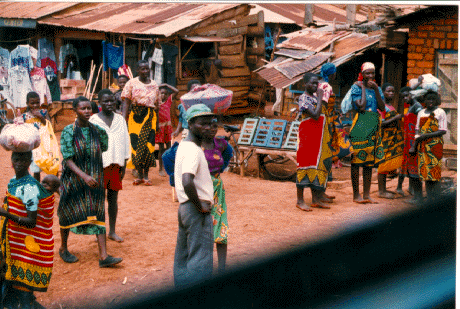 We made a stop in this huge market to take a look and it was so cool. The women here dress in such bright colors – just looking around the market was a spectacle. Hundreds of Burundi women going about their business, but the colors – it was everywhere and brilliant. We left the market and arrived in Bujumbura’s Cercle Nautique campground on the lake shortly after lunch.
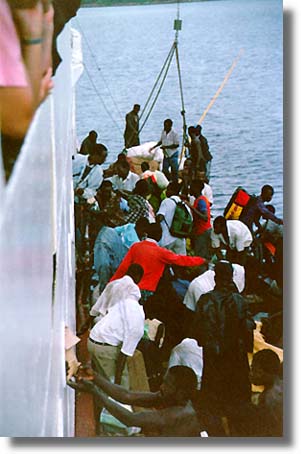 Lake Tanganyika, Between Zambia and Tanzania – Woke up at 2:00 a.m. because it was so damn hot so I grabbed my sleeping bag and moved up to the first class outdoor deck where a bunch of other people from the truck had been sleeping. I awoke in time to see the sunrise, and the best part about it was that I could admire the scenery and sunrise while laying on my bench, warm in my sleeping bag.
 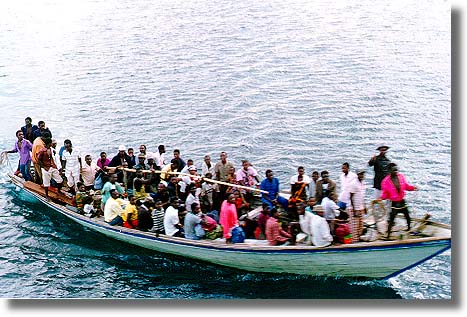 The children in the boats would always call out to us up on the first and second class decks and at one stage I threw a blue ballpoint pen to one boy who had the most amazing smile that went from ear to ear. As soon as he’s caught the pen his face lit up even more – it was exhilarating seeing his expression after receiving something that holds very little significance in our culture. There must have been at least eight stops during our two day cruise, and I don’t think I missed the show at but one of our ports of call during the entire trip. Later on in the evening we had your standard dinner of chicken curry and rice before starting in to the Primus again. Two bottles later we were all crashed out on the first class deck again , ready to go to sleep. I watched yet another lightening storm over the land before actually closing my eyes that evening.