|
|
Writing on the truck doesn’t work, so the writing will just have to be done when it’s possible. That’s the only really frustrating thing about being on the truck – you sit there for six hours at a time and are unable to write, unable to read, unable to do anything but drink and look outside as the truck bounces around on the Third World roads too much. Before we get too far behind (or ahead of ourselves depending on how you look at it) we need to do some housecleaning and write about some of the countries we’ve already left. Let’s start with Malawi some more.
I can’t seem to say enough good things about Malawi, which suits me just fine. Great memories abound. Just take note that my carved Malawian table cost K18.00 (US$3.25). little did we know when we arrived but Malawians eat goat here. One of the S.African guys we met was having a birthday BBQ on the beach, and the guest of honor was Mr. Goat of the nearby village. I guess the S.Africans have these types of BBQ’s all the time. These guys had purchased a live goat that morning, killed it, drained the blood, skinned it and put it on a spit for the locals to cook over an open-pit fire on the beach. Amazing – the goat turned out OK; it definitely tasted like wild game of sorts. Salty and definitely different.
Now you’ll recall we travelled to Blantyre, then Lilongwe before our return flight to Harare. That last night in Lilongwe, Rich and I stayed in the rest house near the bus station. We were both worn down from our bus rides and Rich wasn’t feeling too well, so we decided to be mellow in our hotel room. We had a bit of a cob left over, which we had to dispose of before leaving the country, so we disposed. We then proceeded to pull out my travel radio and tune to Malawi’s sole radio station.
It was so surreal – we were sitting on a bed playing cards, watching the African mothers walk by with their babies tied to their backs in a sarong, and the orange African sunset in the background. Amazing. We started to play cards when these really bizarre radio ads/programmes came on, only adding to the surreal experience. Rich commented that this would be the perfect intro to an episode of the Twilight Zone.
[Opening Credits.]
[Twilight Zone Intro]Voice Over: Two men, sitting in a balmy hotel room in the middle of East Africa, playing cards and relaxing listening to the radio. They’ve just begun their African holiday, but it won’t be a holiday for much longer.
[Wide shot of hotel room, zoom in to close crop shot of actors on bed.]Voice Over: Their only source of information from the Western World, their link to this isolated world in one of the darkest places on the African continent, the hand held FM radio tuned to the sole station in the country – Radio Malawi.
[Actors playing cards, listening to radio. Radio announcer interrupts programming with bulletin.]Announcer: The News. Radio Malawi. The continental United States has just experiences a major earthquake on an undiscovered fault running from the east to west coast. The quake has been classified as a 10.2 on the Richter scale, but this reading is not accurate as the quake was greater than any ever experienced on the planet. As a result the continental shelves have separated and the continent is sinking at a rate of five meters an hour into the Pacific and Atlantic oceans. Millions of people are estimated dead from the initial shock with an infinite number in danger of drowning as the continent sinks. The earthquake has caused tidal waves in all directions heading for Europe, Africa, Asia and Australia, and aid is unable to reach the survivors on North America. All U.S. citizens are urgently required to contact their closest embassy or consulate so the U.S. Government can tally the number of survivors and establish a new government.
How about an episode that went something along those lines, eh? Notes to continue: Denver, capital city. New world power emerges. Expats to form new government.
Alright – that winds up everything I wanted to write – I think.
We flew back to Harare and went right back to the Sable Lodge. When we arrived it was like we were back home. The reception dudes all welcomed us back and come of the people we’d met before we left were still hanging around the Sable. I’ve met some really interesting people – one of them who had the most amazing story was this Russian guy named Serg.
He was about my age, 23, and he had fled from Moscow when Russia was still very communist and they weren’t letting people travel yet. Serg had had his passport taken from him so he decided he needed to get out of Russia. He bought his friend’s Russian passport, went to the airport and got on the first flight out. The only flight leaving the country was to Lusaka, capital of the nearby country of Zambia. Serg got on the plane and he said he had no idea where Lusaka was. He thought it was in Latin America somewhere – he wasn’t expecting Africa at all. He said he got to Lusaka, knew barely any English and just had to figure out how to survive. He said he bought another passport on the black market and came to Zimbabwe because he didn’t need a visa to get in the country. He had lived in Harare for a while and during that time he asked the Russian embassy to issue him a passport (this was before the coup) but the embassy declined his request. Immediately after the attempted coup in 1991 he asked for a passport again and got one issued that would allow him to travel only back to Moscow and no where else. He thought staying in Zimbabwe a bit longer sounded like a good idea. It’s wild – the stories you hear from the travellers who cross your path. They’ve done a lot, but so have we so we can always reciprocate a story.
Upon our return to Harare Rich and I desperately needed to mail home the five to six kilos of wood carvings, tables, etc we’d picked up in Malawi. Hit the post office, which was so efficient. For Z$7.00 (US$1.15) you can ship anything that’s two kilos or under. Amazing! Plus, the packages sent from Zim usually make it home. After our post office escapade (that took us two hours to package and send, etc.) we dropped by the Air India office to set our date leaving Nairobi. That done it was back to the Sable Lodge where we met the other three guys who we’d be on safari with us. Earlier that morning (the 19th) we’d attended our pre-departure meeting for our six and a half week safari from Harare to Nairobi where we’d met these guys. After an evening of talking to these guys it was off to bed.
Maybe it’s a good idea to introduce a few of these guys since they’ll be features prominently over the course of the next six weeks. There are two Aussie guys – Jim and Tom. Jim used to work at a bank – Citicorp, and he’s off to London to work for a year on their two year work visa thing. Tom is taller and not as bright, his last vocation being a plumber, but he was en route to London as well.
 Woke up this morning and lounged around. Rich and I thought we should go haggle with the sellers to get some stone carvings, so we rummaged through our backpacks looking for anything else we didn’t want. You see, no one tells you this, but when you cross over the border into Malawi, everything in you pack all of a sudden is worth something. The Malawians don’t have a lot of stuff, so you can get good deals for clothing, etc to trade. In order of importance one should bring: shoes, towels, baseball hats, and t-shirts. Socks, watch batteries and extra backpacks are helpful. The only thing is there’s a trick to trading. Malawians are very relaxed businessmen. They take their time, so haggling can take you well over an hour for one session. (3-4 sessions are usually required) You sit there and haggle over the price, then when it’s a decent price you pull out the goods to trade. We didn’t know this was the best way to go about it, so we’ve been showing the sellers the trading goods first and instead of getting a straight trade it usually knocks 50% off the price. Then you’ve really got to work to haggle the price down. For a pair of river shoes and $3 I got a chair and a statue for my grandmother. For a pair of socks, a nylon mesh laundry bag and $2.50 I got two figurines and a carved boat for my parents. The only thing is that after 2-3 days and 3-4 bargaining rounds later you get really tired and just pay the twenty five or fifty cents you were arguing over. Woke up this morning and lounged around. Rich and I thought we should go haggle with the sellers to get some stone carvings, so we rummaged through our backpacks looking for anything else we didn’t want. You see, no one tells you this, but when you cross over the border into Malawi, everything in you pack all of a sudden is worth something. The Malawians don’t have a lot of stuff, so you can get good deals for clothing, etc to trade. In order of importance one should bring: shoes, towels, baseball hats, and t-shirts. Socks, watch batteries and extra backpacks are helpful. The only thing is there’s a trick to trading. Malawians are very relaxed businessmen. They take their time, so haggling can take you well over an hour for one session. (3-4 sessions are usually required) You sit there and haggle over the price, then when it’s a decent price you pull out the goods to trade. We didn’t know this was the best way to go about it, so we’ve been showing the sellers the trading goods first and instead of getting a straight trade it usually knocks 50% off the price. Then you’ve really got to work to haggle the price down. For a pair of river shoes and $3 I got a chair and a statue for my grandmother. For a pair of socks, a nylon mesh laundry bag and $2.50 I got two figurines and a carved boat for my parents. The only thing is that after 2-3 days and 3-4 bargaining rounds later you get really tired and just pay the twenty five or fifty cents you were arguing over.
We’ve also figured out that virtually all the locals can provide at least two of the following services for hire: cooking, cleaning, selling ganja or transport. The local we’ve befriended – Patrick – cooks our dinner and banana cakes, can do laundry, can get us cobs and can arrange to have a boat take us to the other islands. The Malawian people are all really friendly and accommodating, the only thing is that some travellers abuse their position. We’ve met some South Africans who treat the blacks like second class citizens. Worse than any active/pledge fraternity relationship ever was. They just order them around and scream at them. When Patrick wanted to talk to me one of the S.Africans came over and said “That black wants to talk to you.” It was like “black was a noun, not a person. It is disconcerting, so we just don’t hang around S.Africans much. The S.African women are all fine, just the men who are obnoxious.
I mentioned that Patrick was gesturing to talk to me. Mr. Stevens (where we’re staying) has its own stretch of beach where the locals aren’t allowed to go. The locals would constantly come over and try to sell the backpackers their services, so to keep them away Mr. Stevens hires someone to chase after the sellers with a large stick. Corporal punishment – I guess it’s effective. The locals all stand outside invisible boundaries like children playing a game of tag who can’s cross a certain line in the sand.
Patrick’s cooked for us for a few nights, so yesterday ha and I had to go to the village to talk to a fisherman about hiring him to take us across the lake. The fisherman wanted too many Kwacha, but on the way back Patrick took me through the village. He showed me the church, then we went to his hut. It’s made of bricks, coated in mud, with a thick straw thatched roof. The area is surrounded by a bamboo fence, enclosing a few papaya trees in the process. Met his sister and her new baby before heading to the grain grinding building
 Cape MacClear, Malawi – Cape MacClear, Malawi –
We met these two British girls (who turned out to be medical students) at breakfast named Cathy and Karine. Wednesday night they’d organized a local to cook a barbecue on the beach and they invited us along. Went down with them to the beach Thursday night and had a good dinner of BBQ fish, rice & tomato sauce (what’s new). After getting thoroughly wrecked it was off to the bed. Thursday (November 12th) we woke up and met a group of people here at Mr. Stevens to go down to the beach, for we’d arranged a boat to take us over to one of the islands to go snorkeling for the day.
Here’s the cast – 1 Brit, 2 Aussies, 1 Kiwi and us. We met our captain who rowed us across the lake over to the island. We found our spot to sit, the everyone was off into the water to start some snorkeling. While we were swimming Queua (our captain) started the BBQ and began to cook the huge catfish he’d brought along for our lunch. We had an incredible fish lunch, after more swimming (and everyone else had made a very poor attempt to row the boat around) we all piled back into the boat for our return journey.
We arrived back in the early afternoon, just in time to meet our BBQ chef, Patrick, from the evening before. In addition to doing evening BBQ’s Patrick can cook some of the best local banana cake around. The locals make “special” banana cake for K5.00, and boy do they do the trick. If you eat too much special cake it just does your head in.
This would be the perfect time to explain to the reader what we’ve figured out about the Malawian people. Every male you meet almost always can offer two or more of the following services: the first one is usually “Take a boat?” [there’s a tie for numbers two and three], 2./3. – laundry, BBQing, 4. Making you a “special” banana cake, and 5. Is whether or not you need a cob. When you can show up in a country and hire virtually any local to do the cooking, cleaning, smoking and transportation, that’s a place you’ll want to spend some time.
Wednesday Rich and I walked down the beach towards “The Gap” [INSERT HAND DRAWN MAP HERE] but we got lost and ended up climbing over tons of hug boulders in our thongs. This local climbed with us showing us the way and when we finally reached the beach near The Gap we asked the local if he’d go back and get his boat to we could get a ride back to shore. We didn’t even know he had a boat, but we asked anyway and he went and found a boat. It’s yet another example of how everyone’s available for hire – and they can almost always do a few of the basic services.
Back to Patrick. Patrick had whipped up one of his banana cakes, so Rich and I went and got Cathy and Karine (the British meds) and promptly sat down and ate the cake as our hors d’overture before dinner.
I looked at a calendar today and realized our flight doesn’t leave until Wednesday, so we’ve got another day here. We’ve become markedly less active in the last few days.
Let’s finish the BBQ story first. After our pre-dinner snack we had a few beers, then headed to the beach. After a spectacular sunset of the most brilliant reds and oranges we laid back to look at the stars. Cape MacLear is so far removed from everything that you can see all the stars clearly. We sat there and looked at the stars but didn’t know any of the constellations because we were all from the Northern Hemisphere. We have as of yet to find anyone who can point out the Southern Cross to us. Because it’s so dark here you can see tons of shooting stars. The best one I saw was huge and it went streaming across the sky, leaving a brilliant white trail that looked like a 4th of July firework. Amazing. Patrick, the local we’ve contracted out to BBQ for us, served up the fish and rice and we had a relaxing meal.
Wasted any lying on the beach looking at the stars Karine started talking about chocolate, which eventually led to Hob Nobs. She and Cathy had been travelling for two months and absolutely wanted Hob Nobs. Karine was saying how nice they were and how nice it would be to have a Hob Nob or two. I made an exit to our room, and when I got back both the girls were laying on their backs and Rich and I sitting above them on the beach. Upon my return Rich asked me for something but my reply was “Not unless it’s made in England.” I then held out a half a package of Hob Nobs that I’d put in my backpack in London five weeks earlier and said, “These are made in England.”
Both Karine and Cathy looked at what I was holding, but because they were looking at me upside down they couldn’t see what it was. “What are those?” asked Karine. “Hob Nobs from England,” was my reply using my game show announcer voice. Upon hearing my response Karine quickly rolled over and after taking a second look at my hand she asked me with eyes the size of plates, “Can I touch them? Are they real?” They were truly amazed that we were sitting in one of the remotes places in the center of East Africa craving Hob Nobs and they suddenly appeared. Cathy reached out and touched the packet upon hearing Karine’s question as Karine couldn’t believe it. “This package of Hob Nobs left England five weeks ago and has since been to Egypt, Kenya, Zimbabwe and Malawi. Let’s enjoy them,” I explained. And on that note we munched on some chocolate covered oat cookies that had been through hell but tasted so nice.
We didn’t see Karine or Cathy the next day because they’d gone, but I’ve got their address and will give them a ring in England to recollect what we’ll call the Hob Nob story.
Here’s the text from the Christmas postcards which are being mailed out: “Nov 18, 92. Dear ——, MERRY CHRISTMAS! We’ve made it to Malawi for the two weeks we had to kill before our safari. This place is heaven. We’re staying in one of the few modern buildings in a village made of thatched huts at Cape MacLear, Lake Malawi. The lake has over 650 species of fish to snorkel after. When you get in the water for a swim the fish come to you and surround you while you’re swimming. We eat fresh fish and rice for dinner; mangos, eggs and coconut for breakfast – if I didn’t have to catch the safari truck on the 20th I’d stay here. It was a hellish bus ride getting here but well worth it. We’re getting a local to take us in his boat (carved out of a tree) over to one of the islands to do diving and eat fresh fish for the day. (That’ll cost $3.00). our room opens up onto the beach and it’s got our own bathroom for $2.50 each. All we do is lounge on the beach and swim all day. Remember, I’m south of the equator and it’s summer down here! Have a great Christmas! We’ll be in Nairobi on the 3rd or the 4th before we go to India to sit on more beaches.. Take Care. All the best. Love, Brad”
Yesterday we sat on the beach, went swimming, sat on the beach, went swimming, sat on the beach . . . That’s how difficult the day was.
From the moment we set foot in Nairobi, everyone we’ve spoken to has said Malawi is amazing. They were all correct. We’d been talking to people at the Sable Lodge in Harare about the various ways one could get to Lilongwe, the capital, from Harare. The shortest way is via the Tete corridor a.k.a. the ‘Gun Run’ which is a highway that runs through the shortest point of southern Mozambique, straight into southern Malawi. As Mozambique is currently in the middle of a civil war, the rebels think it’s a hoot to fire on the truck convoys (which are all accompanied by Zimbabwean national guardsmen) that the hitchhikers and travellers ride on. The alternative is to go around Mozambique via Zambia. To hitch it’ll take two to three days and to take a bus would be twenty three hours. The final alternative is to take a one hour flight Harare-Lilongwe.
After weighing the options we decided to fly. We’ve got two weeks to kill, so why not fly to a country we won’t be visiting on our safari. So that was that; we bought our ticket and arrived in Malawi on November 8th. We met this South African couple, Ian and Dee on the plane, and they directed us to the Lilongwe Golf Club where we rented a tent and slept for our first night. We seem to move from country club to country club as we go. We camped there the first night and the next morning we went with Ian & Dee to the bus station to get a bus to Monkey Bay (near the popular Cape MacClear National Park – our destination). We got to the station and got our ticket for the 8:30 a.m. bus that morning. Ian and I wanted to change some money on the black market before leaving, so we found this guy near the station who bundled us into his friend’s car and took us to a nearby photography studio. Upon entering we were led through the back room into a maze of residential living areas. We walked through narrow outdoor paths, filled with people bathing from the taps in this path. We passed a bank of sinks filled with people brushing their teeth, one woman washing her hair; we’d entered through the photography studio and ended up in the middle of an outdoor residential compound. We arrived at this guy’s friend’s room where we entered and exchanged our dollars for a couple of stacks of the Malawian Kwacha. [Bank rate – USD$1 = K4.2 Black Market – USD$1 = K5.5]. Transaction was done so we were led out to the street and headed back to the bus station to meet Rich and Dee.
The city of Lilongwe is beautifully landscaped – there are Malawian flags everywhere you go (in addition to portraits of Hastings Kamuzu Banta, the ruling dictator) and it’s really lush and green. We got on our bus, which turned out to be a local’s bus because there was no express bus, ready for the journey to Monkey Bay. The bus left, and it was absolutely packed with people, in addition to it being hot and humid – off we went. We passed thatched hut after hut the entire way across the country. If you remember the sets from the show Gilligan’s Island, that is the way the Malawians were living. We saw so many villages along the way – it did show us how the locals lived; that and the fact that the woman in front of us had a guinea fowl seated in her lap for the duration of the bus ride.
The bus ride seemed never-ending, and every time we stopped we’d buy something to eat or drink by leaning out the window and buying it from the local children. The bus was so uncomfortably hot and humid and we’d been sharing our water with the South Africans and we were almost out so we were relying on the non-thirst quenching downing of the African version of orange drink. The bus did leave at 8:30 that morning, it was 2:00 p.m., hotter than hell, humid, there were three times the safety allowance of people on the bus (all standing) and there was a tree blocking the road. People were a little bit on edge. The bus had to drive off the road along the side of a steep ditch and at the angle we were riding at I was absolutely positive that the bus was going to roll. I had my hands up in the air and I was crouching on my seat ready to jump when the bus did. Our bus slowly righted itself, eased back up onto the road and arrived at Monkey Bay around 4:30 p.m., but we still had to arrange for a car to take us the last 21 kilometers into Cape MacClear. Ian and I tried to call some people of the lake to come pick us up, but we couldn’t get through so Ian flagged down a local with a pickup truck and basically hired him to drive us the distance to Cape MacClear.
He drove us on a bumpy, rocky, unpaved road through the National Park, which was filled with baboon and an unidentifiable animal that looks like a rabbit with short ears. The village is made entirely of mud huts with thatched straw roofs – absolutely amazing. We ended up staying at a place called Mr. Steven’s where many a traveller end up. We paid K12 (US$2.10) for a double room with screens to keep the mosquitoes out. After getting cleaned up and took a better look around. It was a brilliant full moon so we could see the water, boats and the hillsides clearly at night.
Lake Malawi amazing – you go through hell getting there, but it’s well worth it. The lake is massive and right off Cape Maclear there are no less that three islands which you are able to hire a local to take you out to. The water is warm – like 70°.
* * * * *  This place is stunningly beautiful. Today we’re just sitting on the beach at the Golden Sands vegging out. We met Ian and Dee earlier and walked over the top of the hill to Otter Point to go snorkeling. Since the entire place is a national park the fish are protected from the fishermen. There are more fish here than I think I’ve ever seen! It’s above and beyond even Hawaii. You get into the water which is packed with the live animals and instead of swimming away the fish come up to you to find out what you’re all about. When you swim along the fish just move out of the way. I was even doing cannon balls off a rock into the water and it didn’t disturb the fish. The only way to describe swimming in Lake Malawi with the fish is to liken it to swimming in an aquarium. There are tons of fish all around you at all times. The Malawian people are all so friendly and they bend over backwards to help you out. Everything everyone has said about Malawi is true – the place is paradise; the best place we could think of to kill two weeks! This place is stunningly beautiful. Today we’re just sitting on the beach at the Golden Sands vegging out. We met Ian and Dee earlier and walked over the top of the hill to Otter Point to go snorkeling. Since the entire place is a national park the fish are protected from the fishermen. There are more fish here than I think I’ve ever seen! It’s above and beyond even Hawaii. You get into the water which is packed with the live animals and instead of swimming away the fish come up to you to find out what you’re all about. When you swim along the fish just move out of the way. I was even doing cannon balls off a rock into the water and it didn’t disturb the fish. The only way to describe swimming in Lake Malawi with the fish is to liken it to swimming in an aquarium. There are tons of fish all around you at all times. The Malawian people are all so friendly and they bend over backwards to help you out. Everything everyone has said about Malawi is true – the place is paradise; the best place we could think of to kill two weeks!
Still hanging out at our country club here in Harare. Yesterday (November 5th) was an incredibly uneventful day full of embassy hopping. Uneventful that is until Rich got thirsty. It was way hot, and an hour before, Rich’s Zaire visa application had been rejected because he didn’t have a shirt on in his visa photos, so he wasn’t pleased about that either. He bought a beer to drink on the walk from the Zairian embassy to the Tanzanian embassy. We’ve been in Zim long enough to see the British influence so Rich made the assumption that you could drink in public, as you can in London. He was about half finished with his beer when a Zimbabwean cop came over and asked him why he was drinking a beer in public. Rich said it was extremely hot and the cop responded by stating it’s illegal to drink alcohol in public.
Rich responded he didn’t know it was illegal so the cop arrested him breaking the law. “Ignorance is no excuse for disobeying the law”, said the cop. We started walking with the cop and he started asking questions like where were we from, where were we staying, etc. We got a lot of questions about the types of hard currency we were travelling with; he wanted us to give him some hard currency so he’d let Rich go. He walked with us for a long time towards our hotel, which eventually put us at a grocery store. The cop seemed to be losing interest since we didn’t have any hard currency, or so we’d said, so he allowed us to go into the store to get some food (escorted by the cop). We took a long time in this grocery store, then once we’d paid we slyly left the market, not looking around for the cop who was supposedly waiting outside. No cop – he’d apparently gotten bored with us so we made our way swiftly down the street and back to the peacefulness of the Sable Lodge. Other than that a really uneventful day.
* * * * * Still here on the porch looking across the yard at the swimming pool. Guy Fawkes Night was last evening, so we saw some fireworks from our neighbor’s yard. Rich and I have turned off our brains. (As you can tell by the crap writing.) I used to be able to get ten errands done in a day, now I can only seem to get one thing done a day. It tires you out when you turn your brain off and are all of a sudden forced to use it again!
This next section is my travel companion, Richard Morris’ account of code breaking our Lonely Planet guide book.
Wednesday 4th November 1992, Sable Lodge, Harare
 Oh yeah – perhaps the funniest thing yet. I think I have discovered something of utmost importance: top secret code written in the Africa guide book we have. It came together as several astute realizations pieced together from random thoughts of the last few weeks. Like the four forces of the natural world, electomagnetism, gravity, strong and weak, though superficially disparate, are really just a component of an even greater heaven, so thusly are these different facts. In my book, places listed in the super budget accommodation section, here and there would mention the fact that they had 24 hour hot water. Oh yeah – perhaps the funniest thing yet. I think I have discovered something of utmost importance: top secret code written in the Africa guide book we have. It came together as several astute realizations pieced together from random thoughts of the last few weeks. Like the four forces of the natural world, electomagnetism, gravity, strong and weak, though superficially disparate, are really just a component of an even greater heaven, so thusly are these different facts. In my book, places listed in the super budget accommodation section, here and there would mention the fact that they had 24 hour hot water.
Now, as anyone who has gone to the Bedouin village of Dahab or even here to the relatively plush accomodations at the Sable Lodge knows that this is but chimerical. No one has 24 hour hot water. You’re lucky if you get five minutes a day of hot water, even more lucky if those five happen to fall sequentially. Cold showers become the norm, rather acceptable, and even held with the same adorning awe as are its counterpart, the blessed hot. So, my thesis is that no hotel listed in my book has 24 hot water. If a hotel could afford 24 hour hot water, it’s name would have been withheld from my publication for two reasons. First, and perhaps overtly, the budget traveler cannot afford places with such luxuries. And secondly, less scrutinized than the first reason proffered, there would be no method available to actually communicate this information. To print it plainly that there were 24 hour hot water would only do one of two things, and neither would be the expected. First, travelers searching for steam would go to a hotel that made such a claim.
Now here we must digress for a second. Let us assume that most places don’t have hot water, let alone 24 hours of it, as was suggested earlier by my nascent experience. So if one actually did have it, and prodded the author to include such information in the publication, which of course the author knows to be code for something else and doesn’t want to print it, but if one persisted perhaps one could convince the author to appease with the pen. That leaves a book filled with hotels stating that they have 24 hot water, but only with a minute fraction that actually do. Therefore, if we jump back to our real aim, which is what a traveler does when going to a place listed as having 24 hot water, and consider this problem in the light of this additional piece of information, that the majority, in fact, the totality almost of all the hotels listed in the guide as having 24 hour hot water don’t, then a conclusion can easily be reached. The traveler looking for the 24 hot water is soon disappointed at the claims made on the pages. Naturally, one will come to expect that 24 hot water is as much a reality as window screens in your room. And if there are window screens, that they are new enough not to have holes so large as to let in a mosquito, let alone the entire biting populace. And that’s where I thought it ended.
Until I broke the code. I didn’t realize that there was more to it before I made the connection. If we think more about it, we can see it from a psychological perspective. Somewhere between conditioning and reward and punishment lies the hidden innuendo, the hidden agenda of the author. By virtue of the fact you’re never satisfied at a place listing 24 hot water, you’ll stay away from them, unconsciously, of course; unless you know the code.
Many places where one can travel in Africa, one can obtain marijuana. It’s not difficult to obtain. Not even a hassle, like in the States or London. I mean you walk into a hotel to check in out, and it smells like Death Duber [Dead show?], even when there is a big sign that says no smoking pot. I mean you walk into a place and sitting on the porch is a tupperware container large enough to carry a dinner salad to a party of twelve, full of
ganga. I mean in your stoned forgetfulness you lose track of a doobie, though it’s never lost in your mind, you don’t even know it exists, you forgot about it the second after we finished smoking it’s brother – only the next day, when it’s given back to you by the staff, do you remember that it was lost.
These places cover the map of Africa. I’m not saying I’ve always stayed in places like this, up till now it’s been always hit or miss. We’d relied on words from fellow travelers for good places, regardless of dope. Sometimes yes, sometimes, no, but you could tell more or less the answer ahead of time by the very nature of the communicator. But it was just guesswork with the book, like picking the derby winner, or so I had thought.
It came to me in a verbal tirade at the lack of information in our book, and the sometimes when information was so inaccurate you wonder whether it was actually true of any time in the past or if they were just having a minor laugh at your expense. We’d just walked three kilometers to find the bus terminus, expecting to find there information on buying a bus ticket to Lilongwe, the capital of Malawi. At the terminus, there was no ticket vender nor an information booth, those were back in town, from whence we had just come. On the way to the ticket office, in directions laid down before me like fine mosaic tiles, we past the Harare Information Centre.
We wanted to find information on the bus, we had great directions, but nonetheless, we decided to drop into the Information Centre to see what they had to offer. Once inside we learned the ticket office so promised us did not exist. To get bus information on buying tickets, one had to board bus 27 at the terminus, go to Mtare, a suburb of Harare, where somewhere outside the city center, the ticket selling information center was located. That threw me for a loop. There was something about this folly that irked me deep down. The man in the Centre said he had limited information on the buses, and he showed us what he had. Unexpectedly, he did have the information we needed. It was a few moments after we left that my verbal tirade began.
I remember today as will Clinton remember today. He won the Presidency this morning, a climax to his political career. Myself, I will remember this day because of its anticlimactic aura. Only one thing happened today, I had a verbal tirade, and when you’re stuck in Harare, stoned immaculate, g etting shisted by the shitty book, and have a verbal tirade, it is quite possible you may say more in a few minutes than in the entire rest of the day combined. Perhaps even two days. It w as in this vitriol that I stumbled upon the fact – no, I had a revelation – that the two previous unconnected stories, that of 24 hot water, and that of marijuana, were in reality, just one story with two means of expression. Much like electricity and magnetism are but two forms of expression of the same basic force, these two seemingly unrelated phenomena have but one common underlying meaning. The code. When seen from my angle, it’s all very clear.
So let me jump back to an earlier yet so far uncompleted argument. That was the case that if the book listed that 24 hour hot water existed, two things might happen. The first is the traveler going to the hotel and being disappointed. The second, which was previously not mentioned, is the traveler going to the hotel and not being disappointed. The traveler is not disappointed because the traveler has gone to a hotel that has exactly what he has expected.
Any place that lists 24 hot water is a secret code for ‘this is a hotel where you get stoned. It seems to fit with theory and experience. So far I do believe it is a code, but I may be proved wrong. I will continue to do exhaustive field work, and then spring my news upon the world like a slowly dispersing gaseous cloud full of rain for the desert. Until then I’ll just spark up another ere long I’m proved wrong.
 Harare, Zimbabwe – Harare, Zimbabwe –
Rich and I had planned to get up early and go to the Embassy election party, but we needed to get our passports over to the Zairian embassy so we could get our visa issued; we had a few to get before we could take off traveling before the safari. We took a cab out to the Zairian embassy – way out of Harare in the suburbs, only to be told by the maid of the large house flying the Zaire flag that this was the Ambassador’s residence; we’d have to go back to Harare to get our visas. We asked them to ring us a cab back to town, but they said they wouldn’t – they even went as far as to tell us to go out to the road and hitch a ride back to town. We wandered out to the road, and after walking for five minutes with out thumbs out a nice car driven by a well dressed white Zimbabwean picked us up.
Now Harare, unlike Nairobi is full of white families living in the nice suburbs in the big houses. Plus, you see them walking down the street and shopping like regular people. Nairobi might also have the same amount of white people but you never see them shopping or walking around. The man who had picked us up was a third generation Zimbabwean (Rhodesian) and in talking to him during the ride back into town he really gave us some insight to the way the whites are living in Zimbabwe. In talking to him I got the feeling that he really enjoyed being here in Southern Africa, and I quote, “I think we’re living better now than the colonials did.” [Ten years ago]. He told us about his family, how they were all Zimbabwean and how they go on holidays to Malawi. He was a really personable man, but I could definitely pick up the colonialist attitude there. He also told us that since the Zimbabwean dollar doesn’t convert into Western currency everyone works abroad and brings their own hard currency down to Zimbabwe with them. Voila! Instant millionaires. Many people have overseas bank accounts in which to keep their dollars and pounds.
He dropped us off in the city center where we skipped the Zairian embassy and headed over to the Election Day party instead. It was in the American library and it was full of yanks. They’d set up about six to seven televisions, all bringing in CNN from . . . somewhere – for election day. The returns were in by the time we’d arrived, but we did get to see Bill Clinton give his acceptance speech, which was pretty cool. They served us doughnuts and coffee and we watched a bit of CNN and chatted to the others there.
I met a couple who are Sacramento natives (Ted Morris/Moss) who have since moved to Zimbabwe because of the husband’s work. He’s with the foreign service and is in charge of disbursement of US funds for the whole of East Africa. The funds are earmarked for food distribution and construction. It was pretty wild finding Sacramentens right in the middle of east Africa, but the guy said it happens all the time – they always bump into someone. But why Sacramentens?
I’m pretty impressed with Zimbabwe so far . . . need to but some real estate.
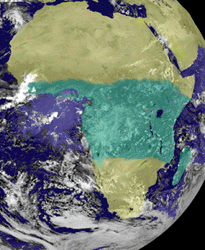
Throughout our travels in East Africa so far Rich and I have come in contact with a lot of travelers, and the one thing that virtually everyone we’ve met has said was, “Malawi is totally amazing.” Malawi? What’s a Malawi? The country! There’s a country called Malawi? Is it in East Africa? I felt I was pretty prepared for this trip; I knew the countries I was going to, and I knew where they all were, but this Malawi place evaded my cartographic studies. We looked at a map and discovered this narrow little country squashed between Zambia, Tanzania, and Mozambique. [MAP IF POSSIBLE TO SHOW MOCAMB Zambia, upper W side, Tanzania on upper E half & Mozambique all around the S half of country]
I first heard of this small country in Africa when one of the British girls at Ma Roche’s told us she’d just returned from there and had the most amazing time. Dean, the hippie there (with long hair) said he’d tried three times to go to Malawi, but couldn’t get through immigration because of his hair. They gave him the option of cutting it or not entering; he voted not to enter. Virtually all the people at the Sable Lodge had been there and all spoke so highly of the life sitting on the shores of Lake Malawi that we were now considering heading there for a couple of weeks before starting our safari. The final straw was talking to the Zimbabwean colonial man who gave us a ride. He said his family went there for vacations, and he couldn’t say enough good things about it. He did recommend not to take the bus because it would be one long uncomfortable bus ride.
We were pretty much decided – we had to go see this place, since we wouldn’t be visiting it on our safari, but how to get there. Mozambique surrounds the bottom half of Malawi, and due to the fact that they were in the throes of a full blown civil war at the time, it wasn’t advised for travelers to take the short cut to Malawi via a highway cutting right through this warring country. The Tete corridor was out, so our next option was to ride buses through Zambia around Mozambique to Malawi. We’d heard that the ride alone could take two days in each direction, and not wanting to waste that many days traveling we opted for the Air Zimbabwe flight from Harare to Lilongwe, Malawi’s capital.
Back at the Sable we started talking to the other travelers to find out where to go in Malawi when I heard about the other trés populaire place to go (it seems) is Mozambique. Now isn’t there, like, a major civil war going on there right now? Yes, I think there is. These girls who were planning to go there paid a shady dude here in our country club some cash for him to go get his friend to forge a Mozambique visa, since they weren’t being issued for tourists. What there girls were thinking I’ll never know. Why would someone travel to a city where the National Army is pulling out because the fighting was so bad? You tell me.
A British girl we met at the Sable had three options of transport to Mozambique:
1) in a car with gun smugglers, 2) in a truck smuggling water into the country, or 3) the 24hr-hot water people (the same guys who can arrange the forged visas). All options sound relatively stupid, but if all these people were headed to Mozambique, there must be something there they’re not telling us about. Even if I knew what were so cool, I wouldn’t go until the army could at least contain the rioting and fighting to one city.
I’ve also noticed that Rich and I seem to have a little bit more available funds than those around us. When we told people in Nairobi we were going to Harare they just assumed we were going overland, not flying. They were a bit surprised when we told them we were flying. We got the same reaction here at the Sable when we told people we were flying to Lilongwe, Malawi. Oh well, such is life – I’ll enjoy it while I can. I probable won’t have any money by the time we get to South East Asia, but until then . . .
A few notes about those staying at the Sable Lodge. There was a very diverse crowd staying there, a few characters as well. I distinctly remember a couple of men hanging out there who were particularly dodgey. One was a tall thin dark complexioned French guy with long dingy brown hair – his name was Pierre. Both his wrists held about ten different silver bracelets each – all Bedouin silver according to him. His buddy was their leader – the guy with the serape type top, the stockier build and always possessing a cotton woven backpack. That was the Spaniard, Javier These two guys would sleep outside in the porch then take a swim in the pool in the morning to rinse off before the day began. I asked Pierre a few questions and found out he used to live on the Sinai peninsula, learned Arabic and hung out with the Bedouin tribes there. That was where he picked up all the silver on his wrists, along with the stash he and Javier were smuggling into Mozambique in a couple of days. Javier did something even dodgier, but I never found out what it was; there were comments from people closer to Javier than I that said his backpack was full of U.S. cash (somewhere in the neighbourhood of $4000) and that was the reason you never saw him let go of that backpack. I’d heard other rumours that these two had bought one of the proprietors a new watch, and another a bike – that was how they could hang out for as long as they like without getting kicked out. These were the two guys Fran was thinking about driving into Mozambique with? If I were her I’d reconsider my judgement.
At the time we were in Zimbabwe a traveller had to go around the jutting peninsula of Mozambique (right into the heart of Zim) to reach Malawi. There was a direct road to Malawi through the city of Tete in Mozambique, but one would have to drive on that highway where convoys have been shot at by the rebels fighting in that country. I met people who had gone through the so called ‘Tete Corridor’ without any instances of anything, and I also met people who had been shot at during their journey. It sounded like a gamble to me, but that is only my opinion at this time of our journey. I don’t know what I’d do today.
Fran met a guy who asked her about it and because she’d talked first hand to a traveller who’d had his friend shot in the chest travelling through the Tete she had very strong feelings about the journey. She basically went off on this guy telling him what a risk it would be. (This coming form a girl who was consciously travelling to Mozambique).
I can remember at one point going out to a proper dinner while staying in Harare. Fran and her friend (Christine?) asked if we wanted to join them for dinner, so we jumped in a cab and hit this Mongolian all you can eat restaurant in downtown Harare. it was a pretty nice place and the food was awesome. It was one of those where you choose the meats and the chef cooks it right there in front of you on a huge grill. It was an amazing dinner and cost us each about US$7 – an outrageous amount of money for a dinner but it was worth it.
There’s a secret code in the Lonely Planet. Look for the term 24 hour hotwater. Rich cracked the code in his short explanation here. Essential reading for all travellers.
Rich and I both really like Harare. This morning we had our first walk around, and I feel really comfortable here. The city is clean, hot (at times) and from the small shopping centers I’ve seen I would think I was in Sacramento if I didn’t know better. The city is so Western; it’s like I never left the States! There are sporting goods stores, arcades, copy stores, stationary stores – all like the ones we’re used to at home. All the streets just outside the 5 x 5 block city center are super wide and lined on both sides with these huge trees, each flowering beautiful red and purple flowers. It’s like being in a forest of the things!
We wandered around, then headed over to the U.S. Embassy to get a letter of recommendation so we could apply for our Zairian visas. When we went to go pick up our letters they were waiting for the Consulate to return so he could stamp them with the official seal. We happened to be in the waiting room when he returned, so he came out to talk to us. I guess he doesn’t see many Americans, ’cause he just chatted away with us while he was signing the letters. He told us there was an Embassy-sponsored party in honor of the U.S. election, and they’d have CNN on so everyone could watch the returns coming in. The party was at the U.S. Information Agency (library) in downtown Harare, starting at 6:00 a.m. the next morning. No problem, we thanked him for the information and went on our way. We walked around some more, then headed back to the Sable Lodge to get wrecked and lounge around. The Sable is like that – it’s almost too relaxing.
 It is absolutely pissing down with rain this morning; if these are the short rains I wouldn’t like to see the long heavy ones. It is absolutely pissing down with rain this morning; if these are the short rains I wouldn’t like to see the long heavy ones.
After talking to these other travelers, we decided it wasn’t worth it to travel around Kenya on our own right now; if everything gets stolen, then we’re going to have some major problems getting some visas and plane tickets re-issued. Not a risk I’m prepared to take right now. In light of that we changed out plane tickets and are flying to Harare today. We also signed up for an overland safari with Kumuka – both Sarah and Jude took trips with them and had good times. Our safari is six and a half weeks, leaving from Harare on November 22nd. We’ve got some time to kill, so why not head down to Zimbabwe early?
The rain just picked up three more notches – it’s creating a waterfall off the corrugated metal roof over the porch. We’re just hanging out here at Ma Roach’s until it’s time to head out to the airport.
Took our Air Zimbabwe flight down to Harare, arriving late this evening. I can honestly say that I think Air Zim has some of the worst airplane food I’ve tasted. How about four finger sandwiches wrapped in plastic – one, cheese which tasted like the wrapper it came in, and the other made of some tuna or meat something or other.
Upon arrival we got a cab over to the Sable Lodge, which was recommended to us in Nairobi, where we got a couple of beds out in the dorm. We’d been there not five minutes when I went out on the porch and met some other travelers sitting with a local, all of who were rolling the largest jay fays you’ve ever seen. I asked if there was any extra around for a price and the local dude pulled three thin corn cobs out of his pocket. I chose one, paid him Z$25 (US$5) and went back inside to show Rich what I’d bought.
Rich was a little surprised that I’d come across some in the first moments of being there. Our cob (as they’re called) was the length of a medium size cob of corn, with the husk tightly tied around, not corn, but stuff the jay fay brings you. It wasn’t as large as it’s vegetable relative, maybe one inch across, and compressed to hell. You had to work to get the stuff to break up for a session. We sat out on the porch of the backyard and talked to the other travelers staying there.
One of the first things that struck me was that these travelers were more like Rich and I, not the rugged, live in Africa types of Nairobi. (As I see it now maybe I just though they were rugged because they were on the road for so long. We were gone just as long and probably looked as rugged as they did at some points.) Plus, the place we were staying in was indicative of some of the travelers. It’s a 180° change from our accommodation in Kenya. We were staying in what I would call a traveler’s country club for Z$22 (US$5) a night. It was just like a country club as well, with the clubhouse (where we were staying) complete with pool table, 2 large dorm rooms, but not so big it was like a military barracks, and a bunch of regular rooms for people to stay in (for a higher price). There was a porch facing the front of the enclosed compound, where we would sit on the couches smoking, looking out across the lawn and watching the other travelers swimming in the outdoor pool. There were lounge chairs spread out along the grass, as well as more outdoor tables and chairs for those of you who want to play cards or write in your journals.
Wait, it gets better. Every morning there’s a maid who cleans the whole place, there’s a 24 hour security guard on the grounds, and there are other people who will take your order for a grilled tomato and cheese sandwich and bring it to you when it’s cooked. Laundry wasn’t a problem, just a fee, and there was free toilet paper in the clean, Western bathrooms. (That’s a big thing when you have to start carrying it around with you.) Hot water even made a cameo appearance every once in a while, but it was summer, so not that necessary. It was awesome, and since we’d be in town for a few days I wasn’t fussed about the accommodation.
All we did that first night was smoke and get to know the other travelers who were staying there.
|
|